PDF
Proposal Report
Formal proposal report outlining the SafeDriver research problem, objectives, scope, and planned methodology.
View FileLoading SafeDriver
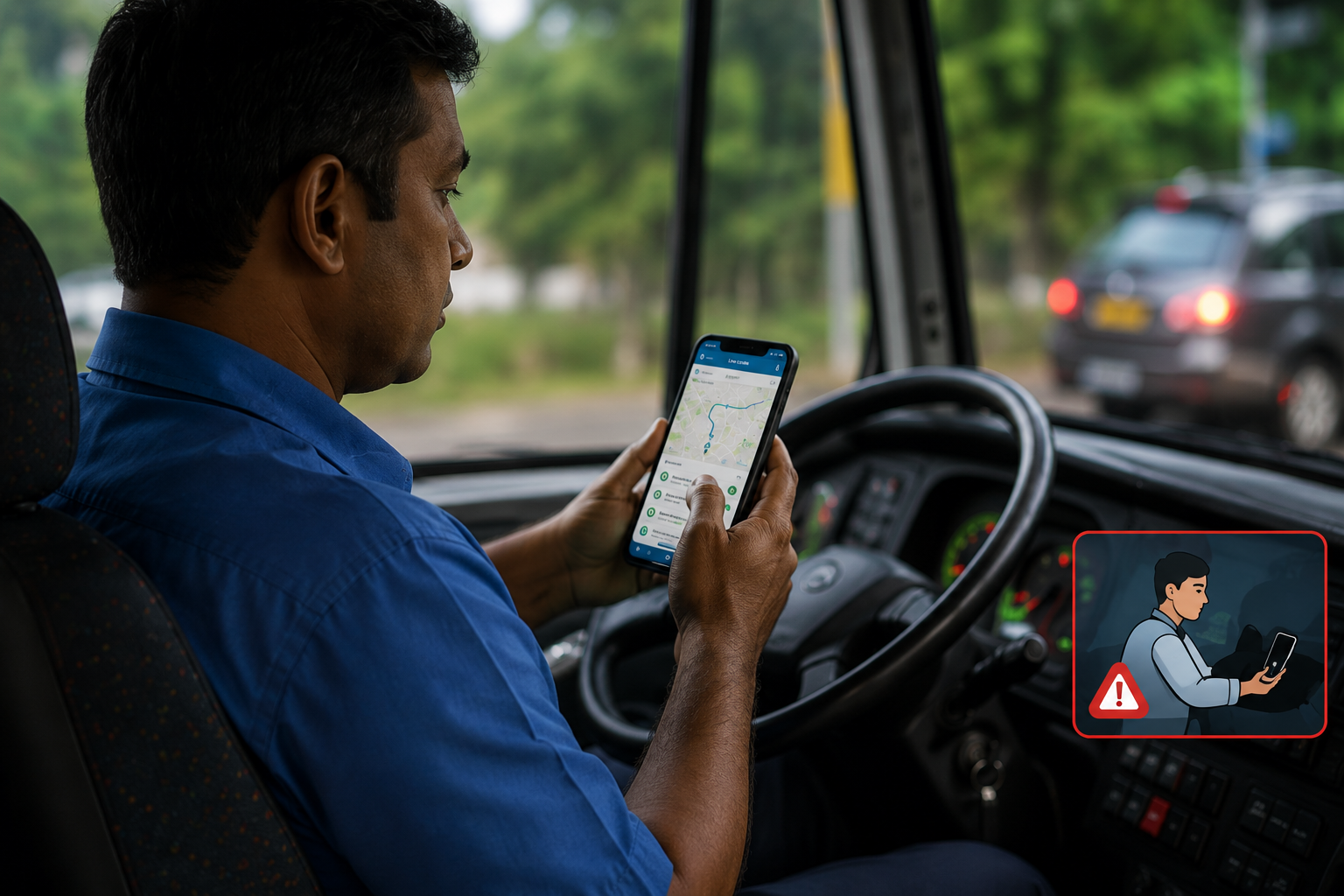
SafeDriver helps passengers, drivers, and operators make every journey more predictable and secure with real-time driver telemetry, live route tracking, AI predictions, and Google Maps integration.
24/7
Live telemetry
AI
Route confidence
Real-time
Safety alerts
Location updates and journey context for safer public transport.
Fatigue, distraction, and behavior cues analyzed in real time.
Fast notifications help operators respond before risk escalates.
Discover how SafeDriver is improving public transport safety through AI-powered real-time driver monitoring and intelligent accident prevention.
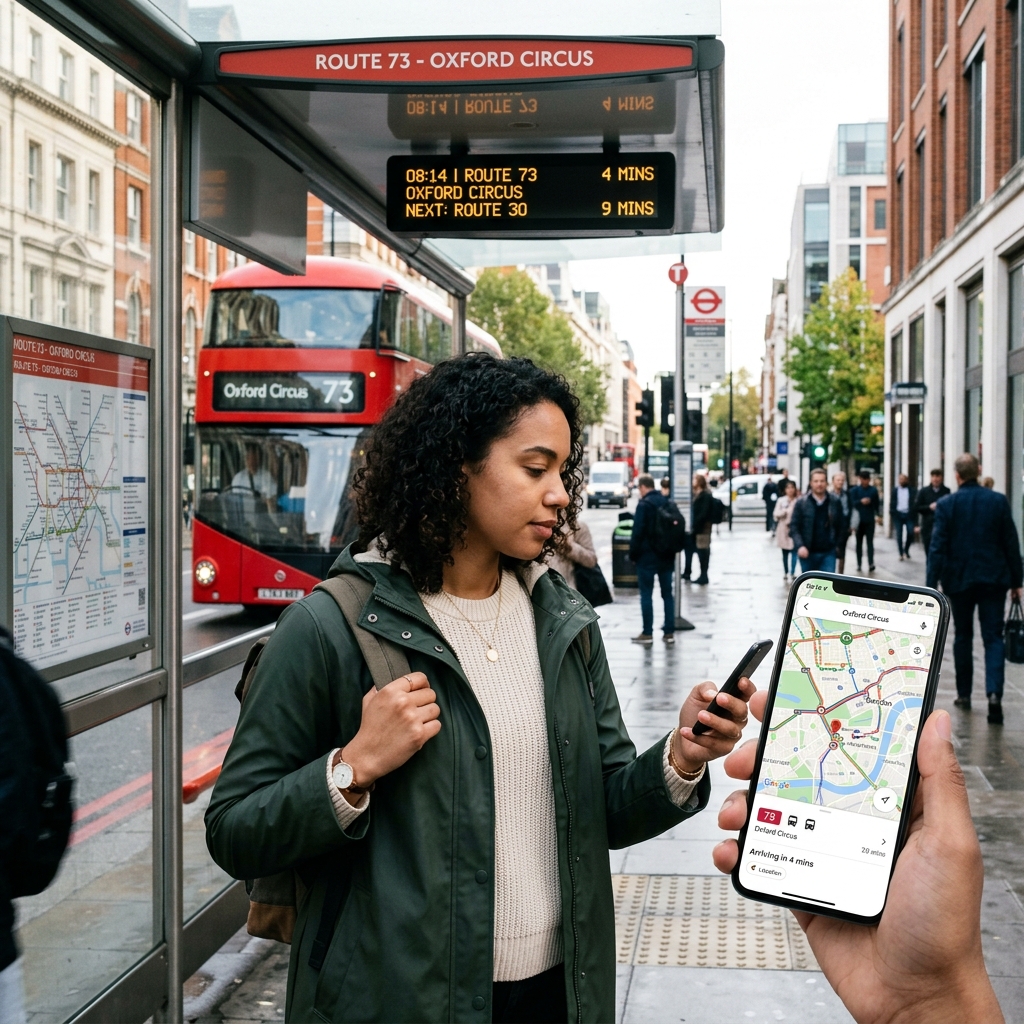
Road traffic accidents remain a major safety challenge in Sri Lanka, particularly in public transportation where driver fatigue, distraction, and unsafe driving behaviors contribute to many preventable incidents. Existing monitoring approaches rely heavily on manual supervision and post-accident investigations, creating a need for an intelligent system capable of continuously monitoring drivers and preventing accidents before they occur.

Public transport authorities currently lack a reliable real-time solution to detect driver drowsiness, mobile phone usage, smoking, and other dangerous behaviors while buses are in operation. Without immediate alerts and centralized monitoring, unsafe driving conditions often go unnoticed until accidents occur, putting both passengers and drivers at significant risk.

SafeDriver utilizes an AI-powered edge-cloud architecture built with Raspberry Pi 4, OpenCV, MediaPipe, TensorFlow Lite, and YOLO to detect driver fatigue and distractions in real time. The system integrates GPS tracking, Firebase cloud services, a Next.js authority dashboard, and Flutter mobile applications to provide intelligent alerts, fleet monitoring, passenger feedback, and comprehensive transport safety management.
The literature survey indicates that although numerous AI-based Driver Monitoring Systems (DMS) have been developed worldwide, many existing solutions primarily target luxury or commercial vehicles and rely on expensive proprietary hardware or cloud-based processing. Most systems focus only on detecting driver drowsiness while providing limited support for distraction detection, real-time intervention, passenger engagement, and transport authority monitoring.
Recent studies demonstrate that computer vision techniques such as MediaPipe, OpenCV, YOLO, and TensorFlow Lite can accurately detect fatigue indicators including prolonged eye closure, yawning, head pose, smoking, and mobile phone usage. However, many solutions require high-performance hardware or continuous internet connectivity, making them less suitable for large-scale deployment in Sri Lanka's public transportation sector.
Modern research also emphasizes edge AI, embedded computing, GPS integration, and cloud analytics for improving road safety. Nevertheless, there remains a lack of affordable, locally adaptable systems that integrate embedded AI, intelligent alerting, authority dashboards, driver mobile applications, passenger applications, and real-time fleet monitoring into a single platform.
Despite significant advances in intelligent transportation systems, several important research gaps remain in existing driver monitoring solutions.
Many existing systems concentrate primarily on drowsiness detection while overlooking unsafe driving behaviors such as mobile phone usage, smoking, head-turn distraction, and prolonged inattentiveness.
Most commercial driver monitoring solutions rely on expensive proprietary hardware or cloud-based processing, increasing deployment costs and reducing performance in environments with limited network connectivity.
Current solutions rarely provide a complete ecosystem connecting drivers, passengers, and transport authorities. Driver mobile assistance, passenger feedback, GPS hazard mapping, centralized fleet monitoring, and compliance reporting are often unavailable within a unified platform.
There is a lack of affordable AI-powered driver monitoring systems specifically designed for Sri Lanka's public transport environment, supporting right-hand-drive vehicles, multilingual interfaces, real-time edge processing, and intelligent multi-level alert mechanisms.
Develop an embedded AI system capable of continuously monitoring driver behavior and detecting drowsiness using Eye Aspect Ratio (EAR), blink frequency, yawning detection, and head pose estimation.
Implement computer vision and deep learning models using YOLO, OpenCV, and TensorFlow Lite to identify unsafe behaviors including mobile phone usage, smoking, head-turn distraction, and driver inattentiveness in real time.
Develop an intelligent alert mechanism that delivers graduated responses through buzzer alarms, voice guidance, vibration alerts, driver mobile notifications, cloud alerts, and authority notifications.
Integrate GPS technology to identify accident-prone locations, monitor bus routes, support hazard mapping, and improve transport safety through location-aware analytics.
Develop a Flutter-based driver application that provides real-time safety alerts, trip information, driving performance insights, emergency notifications, and communication with the cloud platform.
Develop a cross-platform Flutter application enabling passengers to monitor bus safety status, submit driver and bus feedback, access emergency SOS services, scan QR codes, and earn reward points for active participation.
Build a centralized Next.js web dashboard that enables transport authorities to monitor drivers and buses in real time, manage alerts, visualize fleet activity, review passenger feedback, and generate compliance reports and analytics.
Implement Firebase Authentication, Firestore, Cloud Functions, Cloud Messaging, and secure cloud synchronization to support real-time communication, notifications, analytics, and centralized data management.
Discover the AI-powered safety technologies that make SafeDriver an intelligent driver monitoring and accident prevention platform.
Continuously monitors driver alertness using AI-powered computer vision to detect fatigue, prolonged eye closure, yawning, and abnormal head movements in real time.
Uses Eye Aspect Ratio (EAR), blink frequency, PERCLOS analysis, and facial landmark tracking to identify early signs of driver fatigue before accidents occur.
Detects unsafe driver behaviors including mobile phone usage, head-turn distraction, and inattentiveness using YOLO and MediaPipe running directly on the embedded device.
Recognizes smoking behavior inside the vehicle cabin using deep learning models, helping improve driver discipline and passenger safety.
Provides intelligent safety interventions through voice guidance, buzzer alarms, vibration alerts, driver mobile notifications, cloud notifications, and authority escalation based on event severity.
Runs AI inference locally on Raspberry Pi 4 using TensorFlow Lite and OpenCV, ensuring low-latency detection even without continuous internet connectivity.
Provides drivers with live safety notifications, trip information, vibration alerts, driving history, emergency assistance, and performance summaries.
Allows passengers to monitor bus safety status, submit driver and bus feedback, scan QR codes, earn reward points, and access emergency SOS services.
A centralized Next.js dashboard enabling transport authorities to monitor buses, drivers, live alerts, routes, passenger feedback, and fleet performance in real time.
Tracks vehicle location, identifies accident-prone areas, visualizes hazard zones, and assists authorities in improving transport safety through location intelligence.
Leverages Firebase Authentication, Firestore, Cloud Functions, and Cloud Messaging to securely synchronize alerts, driver data, analytics, and notifications across all connected devices.
Generates comprehensive reports on driver behavior, alert history, passenger feedback, safety trends, and regulatory compliance to support transport authorities in decision-making.
Visual implementation highlights from the SafeDriver embedded monitoring system, authority dashboard, passenger application, and driver application.
Raspberry Pi 4-based monitoring system running real-time driver behavior detection with camera input, local alert devices, GPS data, and Firebase cloud transmission.
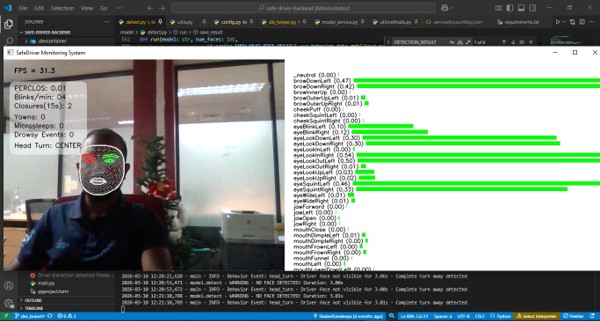
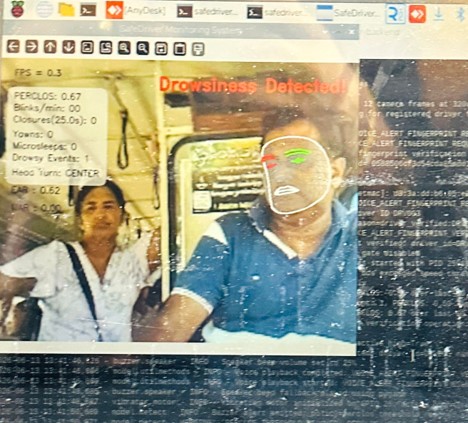
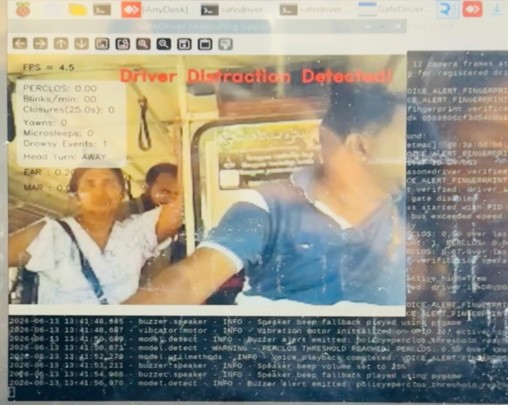
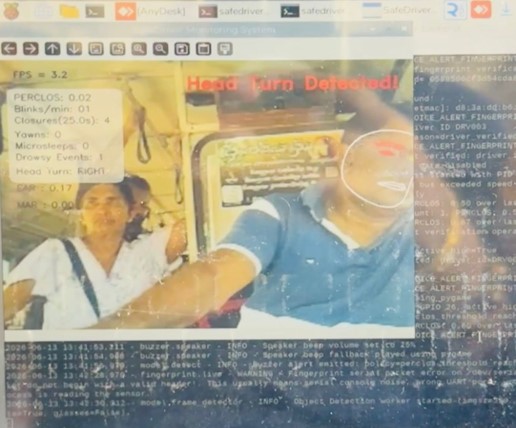
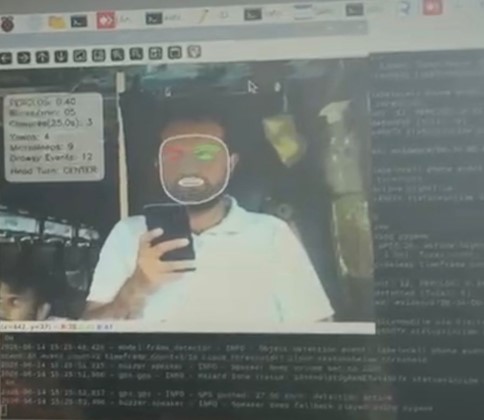
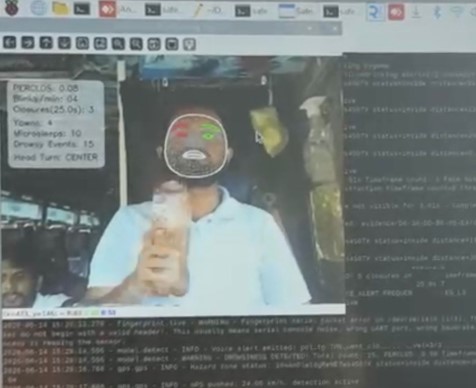
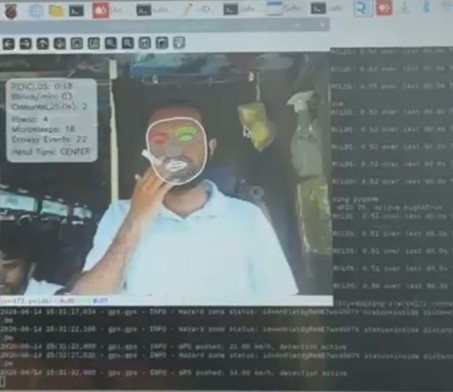
The complete hardware and software ecosystem powering the SafeDriver AI-based driver monitoring and accident prevention platform.
Real-time fatigue intelligence for EAR, PERCLOS, yawning, blink frequency, and head-pose analysis.
Highlighted Tools
Detects distraction, phone usage, smoking, facial landmarks, and driver activity on-device.
Highlighted Tools
Low-latency AI inference and alert hardware for buses without full cloud dependency.
Highlighted Tools
Cross-platform driver and passenger apps for alerts, SOS, QR scanning, feedback, and rewards.
Highlighted Tools
Connects devices, dashboards, mobile apps, notifications, and business logic in real time.
Highlighted Tools
Authority dashboard for fleet monitoring, alerts, GPS tracking, analytics, and reports.
Highlighted Tools
Secure user management, alerts, feedback, monitoring records, and live synchronization.
Highlighted Tools
Collaborative development, version control, Linux tooling, and containerized deployment.
Highlighted Tools
Access SafeDriver project documents, research material, presentation slides, and implementation repositories from one organized section.
Documentation
Formal proposal report outlining the SafeDriver research problem, objectives, scope, and planned methodology.
View FileFirst progress report covering early research direction, system planning, and initial implementation work.
View FileSecond progress report covering developed modules, platform integrations, and testing updates.
View FileThird progress report covering final implementation refinements, validation, and project outcomes.
View FileComplete final report documenting the SafeDriver research, implementation, evaluation, and conclusions.
View FileMeet the individuals behind SafeDriver.

Supervisor
B.Sc. (Hons) (Colombo), Ph.D (OUSL)
Senior Lecturer (Grade I)
Department of Electrical and Computer Engineering
Office Location
CRC, 2nd intermediate floor, Science and Technology building, Room No : W5
Contact